Harnessing community energy in Richmond
Date:
14 September 2026
Author:
Councillor Julia Neden-Watts
Title:
Chair of the Environment, Sustainability, Culture and Sports Services Committee
A new form of energy generation is coming to the London Borough of Richmond upon Thames — one led by local people, focused on local buildings, and designed to deliver long-term benefits for our communities. Known as community energy, it has the potential to cut carbon emissions, reduce energy bills, and bring jobs and funding into the borough.
What is community energy?
In its simplest form, community energy involves installing and maintaining renewable energy infrastructure, most commonly solar panels and batteries, on community buildings. Successful projects have been established elsewhere in London, helping schools and community facilities generate renewable electricity, cut energy costs, and reinvest surplus income in local priorities. These projects have created a growing body of practical experience to draw on.
Community energy projects are typically organised by local volunteers who come together as a cooperative.
The cooperative we're seeking to establish in Richmond upon Thames will be independent of the Council, with local residents leading the work to identify suitable sites, develop projects, manage contracts, oversee maintenance, and communicate with local partners. The Council will support this work by providing access to expert advice, offering start-up funding, and helping to link the group to potential sites for future solar installations.
How it works
The cooperative will be able to raise money from various funding sources, including through a local community share offer, to pay for installations.
Once an installation is in place, the cooperative will provide cheaper electricity to the host building (such as a school or community facility). Any excess electricity can be sold back to the national grid.
The host building will see a drop in energy costs and carbon emissions. People who invest in the scheme can expect a modest financial return. After a set period, usually around 16 years, full control and ownership of the solar panels will be passed to the school or building owner.
Any surplus funds can be used to support local initiatives. These could be non-profits or community projects – it is up to the group to decide.
Any other benefits?
Apart from reducing carbon emissions and lowering energy bills, community energy projects support local investment, create jobs for local installers, and give residents a chance to use their skills and develop new ones.
Community energy also brings people from different networks together. The cooperative could include a retired professional with project management expertise, a young person looking to gain experience, a parent with marketing skills, or a technical professional who wants to put their knowledge to good use.
How the Council is helping
The cooperative will be independent of the Council, though we will support the group in several ways, including identifying potential sites for energy projects. We are also setting up an Accelerator Fund to finance feasibility studies for potential sites.
We have engaged Community Energy London to run a series of educational events and start people thinking about how a cooperative could be established.
We are also linking volunteers with Repowering London, a group that has helped community energy groups set up across the city. Using Council seed funding, Repowering London will help our group get on its feet, offering expert consultation and legal advice, as well as administrative support.
Join us
Please get in touch if you would like to be involved in our community energy project. We have already had two meetings, with another one at Patch this Wednesday 16 September. Find out more and sign up for this meeting.
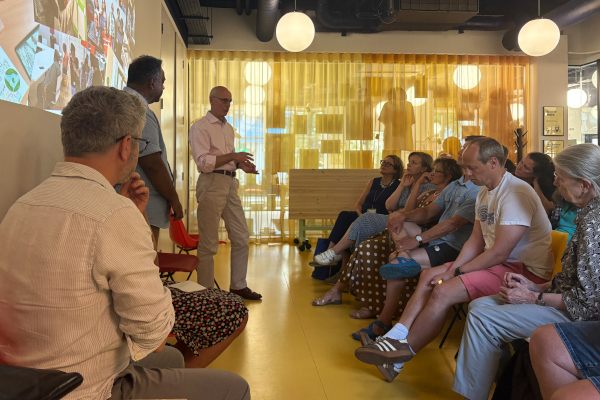
In the near future, we plan to visit a community energy project in another borough to see for ourselves how it all works. Come and join us.
You can also view our recent webinar, which featured a member of Community Energy Barnet describing her experience of setting up their local group.
Please share this opportunity with friends and family who may want to get involved.
Share this
Up to: Council blog 2026
Updated: 14 September 2026